Ford Thunderbird
Ford's long-running personal car, developed from a two-seat 1950s roadster into larger personal-luxury cars, including coupes, convertibles and a four-door Landau, before a two-seat revival.
Overview
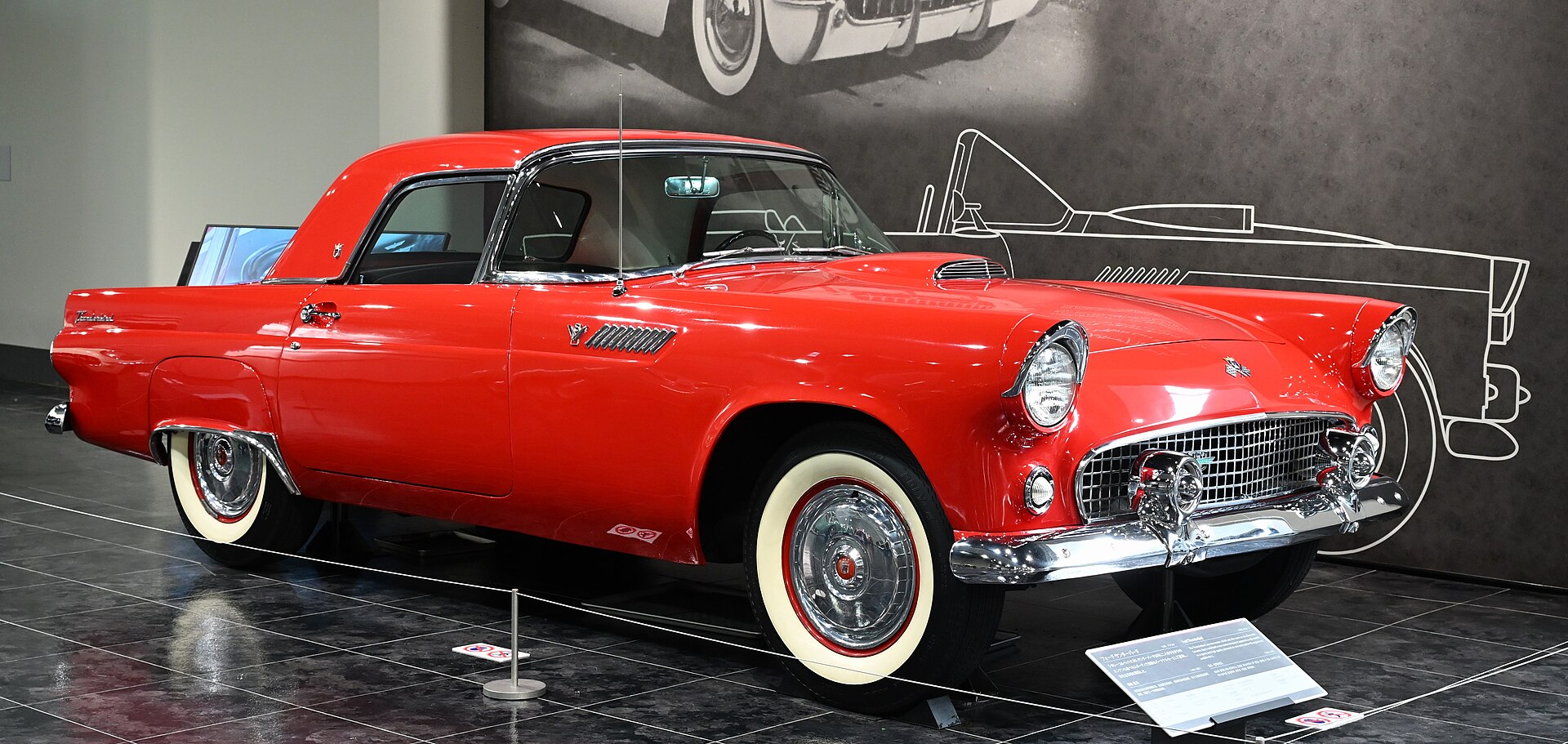
The Ford Thunderbird began as a two-seat V8 roadster for the 1955 model year and became one of the defining American personal cars. Ford first showed it at Detroit’s post-war auto show on 20 February 1954, and the first production car left the Dearborn assembly line that September. Its brief was not simply to build a competition sports car: comfort, recognisable Ford styling and readily available production components were central to the project.
That distinction shaped the nameplate’s development. The original Thunderbird combined a canvas top with an optional removable hardtop, but the second generation added a rear seat and substantially more interior room. Later cars moved farther toward the personal-luxury car formula—a car emphasizing comfort, style and amenities for its owner—growing and shrinking as American tastes, fuel prices and Ford’s platforms changed. Across ten styling generations from 1955 to 1997, the Thunderbird ranged from roadster to hardtop, convertible and even four-door Landau. A final, eleventh generation revived the two-seat format from 2002 to 2005.
Generations
The ranges below refer to model years.
1. Two-seat Thunderbird, 1955–1957
The first generation established the long bonnet, short rear deck and V8 identity. It was sold as a two-seat open car with a folding soft top and available hardtop. Ford positioned its blend of performance, convenience and finish in a space of its own rather than as a narrowly focused racing machine.
2. Four-seat expansion, 1958–1960
For 1958, Ford replaced the two-seater with a larger four-passenger car. Its more angular proportions earned it the later “Squarebird” nickname, and sales rose substantially.
3. Bullet Bird, 1961–1963
The 1961 redesign introduced the low, pointed shape often called the “Bullet Bird”.
4. More formal styling, 1964–1966
The 1964–1966 cars became squarer and more formal. The 1965 Thunderbird also introduced Ford’s sequential rear turn signals.
5. Expanded Landau range, 1967–1971
The 1967–1971 generation broadened the range with hardtop and Landau bodies, including a four-door Landau with rear-hinged back doors.
6. Personal-luxury growth, 1972–1976
The very large 1972–1976 Thunderbird placed still greater emphasis on isolation and luxury.
7. Downsizing, 1977–1979
Ford downsized the line for 1977–1979.
8. Fox platform, 1980–1982
Ford moved the Thunderbird to the smaller Fox platform for 1980–1982 as efficiency became more important. Fox is a platform designation: a name for the underlying vehicle architecture.
9. Aerodynamic coupes, 1983–1988
The all-new 1983 car rejected the boxy styling of its immediate predecessor. Drag coefficient is a dimensionless measure of aerodynamic resistance; a lower value means less drag when frontal area and conditions are the same. Ford quoted a drag coefficient of 0.35 for its smooth body. Verification caveat: Thunderbird-specific support for this figure and its applicable configuration remain to be established. The bibliography’s “1983 Ford Division press material” URL names Bronco II press releases, but the filename alone does not establish what the document contains. The existing source is retained pending verification.
The Turbo Coupe supplied a more performance-oriented identity.
10. MN12 platform, 1989–1997
A further redesign for 1989 used the MN12 platform, with a longer wheelbase and independent rear suspension. MN12 is the designation for this underlying vehicle architecture. This tenth generation remained in production through the 1997 model year.
11. Two-seat revival, 2002–2005
After an absence for the four model years 1998–2001, the Thunderbird returned for 2002 as a two-seat convertible with an available porthole hardtop. Its proportions and details deliberately recalled the 1955–1957 cars, while its structure and V8 drivetrain were modern. Ford ended production again after the 2005 model year, closing an eleven-generation history that had alternated between sporting style and personal luxury.