Ford F-Series
The purpose-built truck range that developed from the 1948 F-1 into the long-running F-150 and Super Duty families.
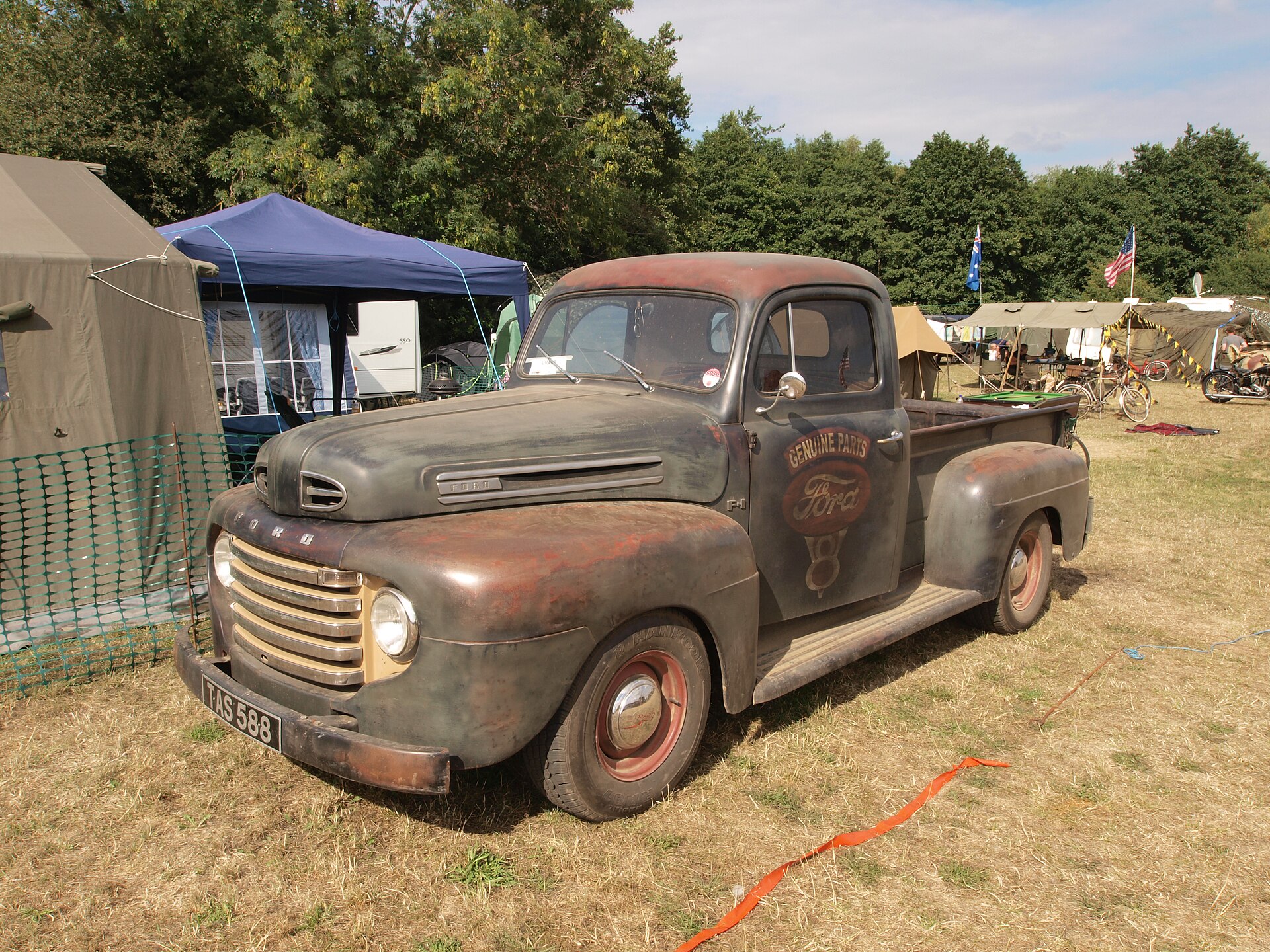
Overview
This overview focuses on the North American F-Series, principally its United States pickup history. Dates identify model years unless explicitly described as calendar dates. The F-Series family includes several truck branches; the F-150 generation sequence should not be applied to every heavier-duty model or to other markets.
Ford introduced the F-Series for the 1948 model year as its first post-war truck design, using a purpose-built truck platform. The original range extended from the half-ton F-1 to the larger F-8 commercial truck. Ford’s retrospective supports these endpoints, but does not establish the earlier overview’s precise description of eight weight ratings ending with a three-ton F-8; those classifications remain unverified here. See Ford’s truck-history retrospective.
Designation changes
The names reflect both renaming and the development of separate branches:
- 1953 model year — renaming: The second generation changed F-1 to F-100, combined F-2 and F-3 into F-250, and changed F-4 to F-350. See Ford’s account of the 1953 changes.
- 1975 model year — addition: The F-150 joined the range between the F-100 and F-250. It initially coexisted with the F-100 rather than immediately replacing it. See Ford’s F-150 anniversary history. The F-150 subsequently became the core light-duty pickup; the F-100’s withdrawal after the 1983 model year refers specifically to the North American range.
- 1999 model year — separate heavy-duty branch: Super Duty introduced a separate platform for heavier-duty trucks, including F-250 and F-350 pickups. Ford’s launch release distinguishes these from the lighter F-150 and F-250 platform, so the F-250 designation alone does not identify the branch during this transition. See Ford’s Super Duty launch release.
The F-Series family history therefore encompasses the earlier F-1 and F-100, the light-duty F-150, and the distinct Super Duty branch; it is not a single sequence of replacement names.
Generations and milestones
These are selected North American milestones. The numbered generations follow the pickup lineage that began before the F-150 name appeared; they do not count generations of the F-150 nameplate alone or establish a shared chronology for Super Duty and commercial trucks. Year ranges below refer to model years.
F-1 and early F-100 (1948–1956 model years)
The first-generation “Bonus Built” trucks established the dedicated truck range, from the half-ton F-1 to the larger F-8. A complete redesign arrived for the 1953 model year with a wider cab, revised chassis and the F-100, F-250 and F-350 naming system. See Ford’s account of the original range and 1953 renaming.
Wider, lower pickups (1957–1979 model years)
Successive generations adopted wider cabs, lower bonnets and increasingly integrated pickup bodies. The Styleside box gave the bed smooth outer panels, while Ford’s Twin-I-Beam independent front suspension appeared on two-wheel-drive pickups for the 1965 model year. The F-150 joined the sixth-generation range for the 1975 model year, alongside the F-100. See Ford’s history of the F-150 introduction.
F-150 becomes the centre of the range (1980–1996 model years)
The seventh generation introduced a lighter, more aerodynamically considered body for the 1980 model year. Subsequent updates carried the F-150 through the 1996 model year, adding more car-like cabins and equipment while preserving separate cabs, beds and chassis for varied work requirements. No count of intervening redesigns is asserted here pending verification of the generation boundaries.
Selected light-duty and Super Duty milestones
The tenth-generation pickup redesign brought rounder styling and greater emphasis on everyday passenger use to the F-150 for the 1997 model year. This generation label belongs to the light-duty lineage, not the subsequent Super Duty sequence.
For the 1999 model year, Super Duty established a separate heavy-duty platform. Ford’s contemporary announcement explicitly distinguished it from the lighter F-150 and F-250 platform. See Ford’s Super Duty launch release.
Within the F-150 branch, EcoBoost V6 engines debuted for the 2011 model year, followed by extensive aluminium-alloy bodywork for the 2015 model year. See Ford’s retrospective on these developments.
This selection is not a complete chronology through the present. The introduction dates and model-year scope of hybrid and battery-electric developments remain outside the verified coverage of this overview; the supplied reference metadata alone does not establish those later claims.
Sources
- Ford company timeline: the F-Series is introduced — Ford Motor Company
- Ford celebrates 100 years of truck history — Ford Motor Company
- A century of Ford truck history — Ford Motor Company
- The Understated Debut of an Icon: Celebrating 50 Years of Ford F-150 — Ford Motor Company
- Ford Intros Super Duty F-Series at SEMA — Ford Motor Company release reproduced by The Auto Channel