Ford Bronco
The body-on-frame Ford Bronco launched for the 1966 model year, enlarged for 1978, was discontinued in 1996 and revived for 2021.
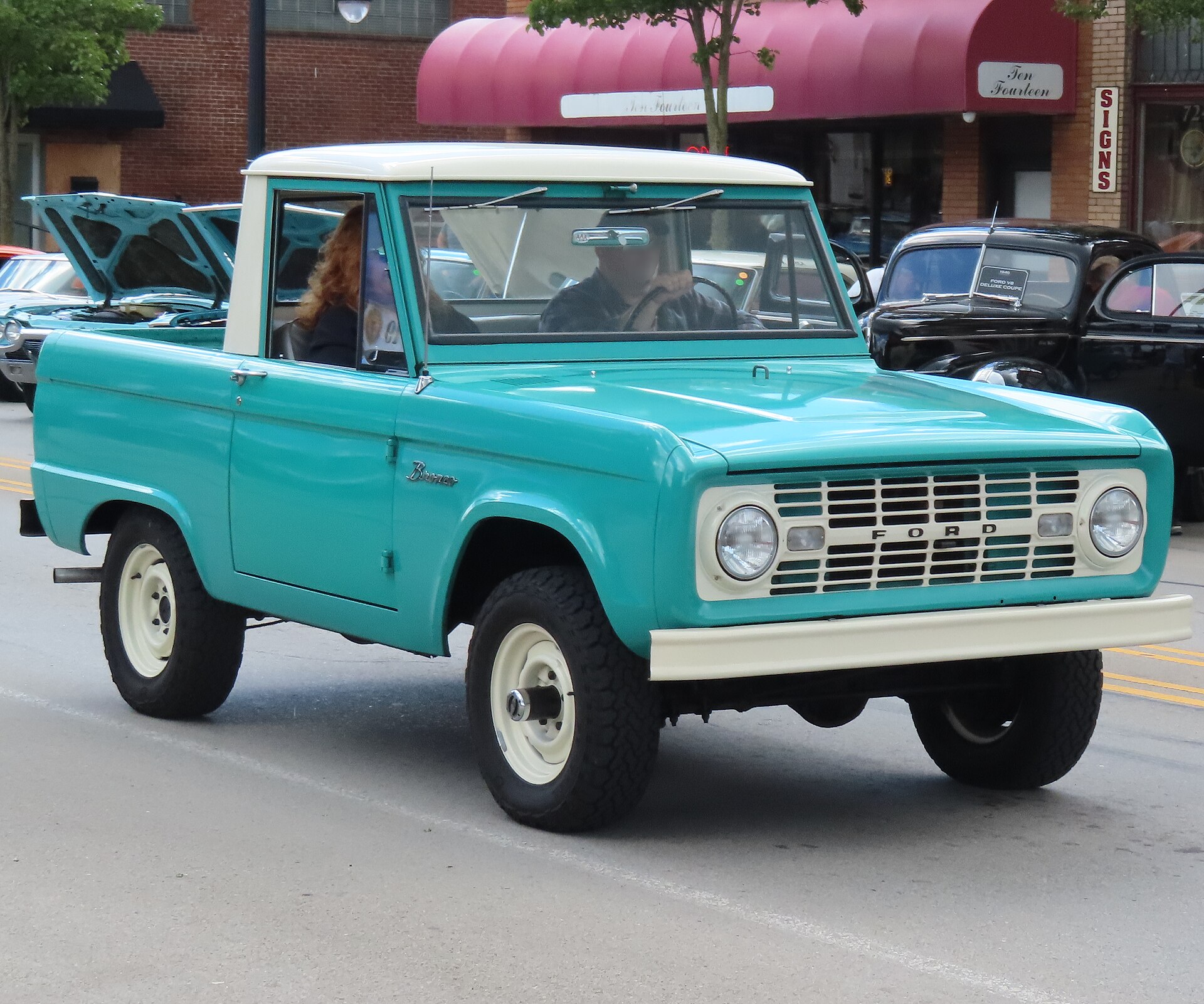
Overview
Ford revealed the Bronco in August 1965 for the 1966 model year. Ford’s historical account describes its introduction as a “Sports-Utility Vehicle” and credits McKinley Thompson’s early sketches with its box-shaped, two-door design. Don Frey described a vehicle combining car and truck functions with off-road versatility. Ford’s historical account
The first Bronco used body-on-frame construction: its body was mounted on a separate supporting frame. It combined four-wheel drive with a short wheelbase—the distance between the front and rear axle centres. Ford offered three bodies: an open roadster without a roof or doors in standard form, a short-roof Sports Utility pickup and a fully enclosed wagon. The simple dimensions and high ground clearance made it manoeuvrable off road, while coil-sprung front suspension gave it more compliant road behaviour than many contemporary utility vehicles.
Ford enlarged the Bronco for 1978 and based subsequent versions on shortened F-Series truck platforms. Five generations were produced before the two-door model ended in 1996. A sixth generation revived the Bronco name for 2021 after a 25-year absence.
Bronco, Bronco II and Bronco Sport
The six-generation history here covers the Bronco itself. Bronco II was a separate, smaller Ranger-based model introduced for 1984. Bronco Sport is a smaller unibody model, whose body structure carries loads rather than sitting on a separate frame. Neither is counted among the six Bronco generations.
Generations
First generation (1966–1977)
The original compact Bronco launched with a 170-cubic-inch inline-six, with V8 power added during its first model year. Ford’s historical account dates the V8 option to March 1966. Ford’s engine chronology
Roadster, Sports Utility and wagon bodies shared the same basic chassis. The roadster disappeared after 1968 and the pickup after 1972, dates also recorded in Todd J. Zuercher’s history hosted by the Bronco Roadster Registry. Body-style chronology
Competition-prepared Broncos also established a successful record in North American desert racing.
Second generation (1978–1979)
The second Bronco was a much larger vehicle derived from the contemporary F-Series pickup. It used a removable rear roof over a full-size two-door body and was offered with V8 engines. Despite lasting only two model years, it set the format followed by the next three generations.
Third generation (1980–1986)
A redesigned Bronco arrived for 1980 on a shorter F-150 platform. It was lighter than its predecessor and introduced Ford’s Twin-Traction-Beam independent front suspension. Six-cylinder engines returned alongside V8s.
Fourth generation (1987–1991)
The 1987 redesign brought smoother front styling. Electronic fuel injection and updated transmissions featured during this generation; Ford’s retrospective discusses them at generation level rather than establishing that every change arrived for 1987. Ford’s fourth-generation account
Fifth generation (1992–1996)
The 1992 revision brought more integrated bodywork while retaining the two-door, removable-roof layout. Safety equipment developed during this generation, rather than all arriving at its launch. Production ended in 1996. Ford’s fifth-generation account
Sixth generation (2021–present)
The revived Bronco returned as a body-on-frame four-wheel drive with separate two- and four-door bodies. Both use removable doors and roof panels. Low-range transfer cases, locking differentials and specialised off-road variants extend the original model’s functional theme; equipment varies by version.
Low-range gearing reduces road speed for a given engine speed and increases the turning force available at the wheels, helping with controlled progress over difficult terrain. A locking differential can make the two wheels on an axle turn together, helping maintain drive when one wheel has little grip. These explanations describe how the mechanisms work, not equipment fitted to every Bronco.