Chevrolet Camaro
Chevrolet's rear-wheel-drive pony-car family, spanning six generations and the 1967–2002 and 2010–2024 model years, with a history linking everyday sporting coupes to competition-derived performance cars.
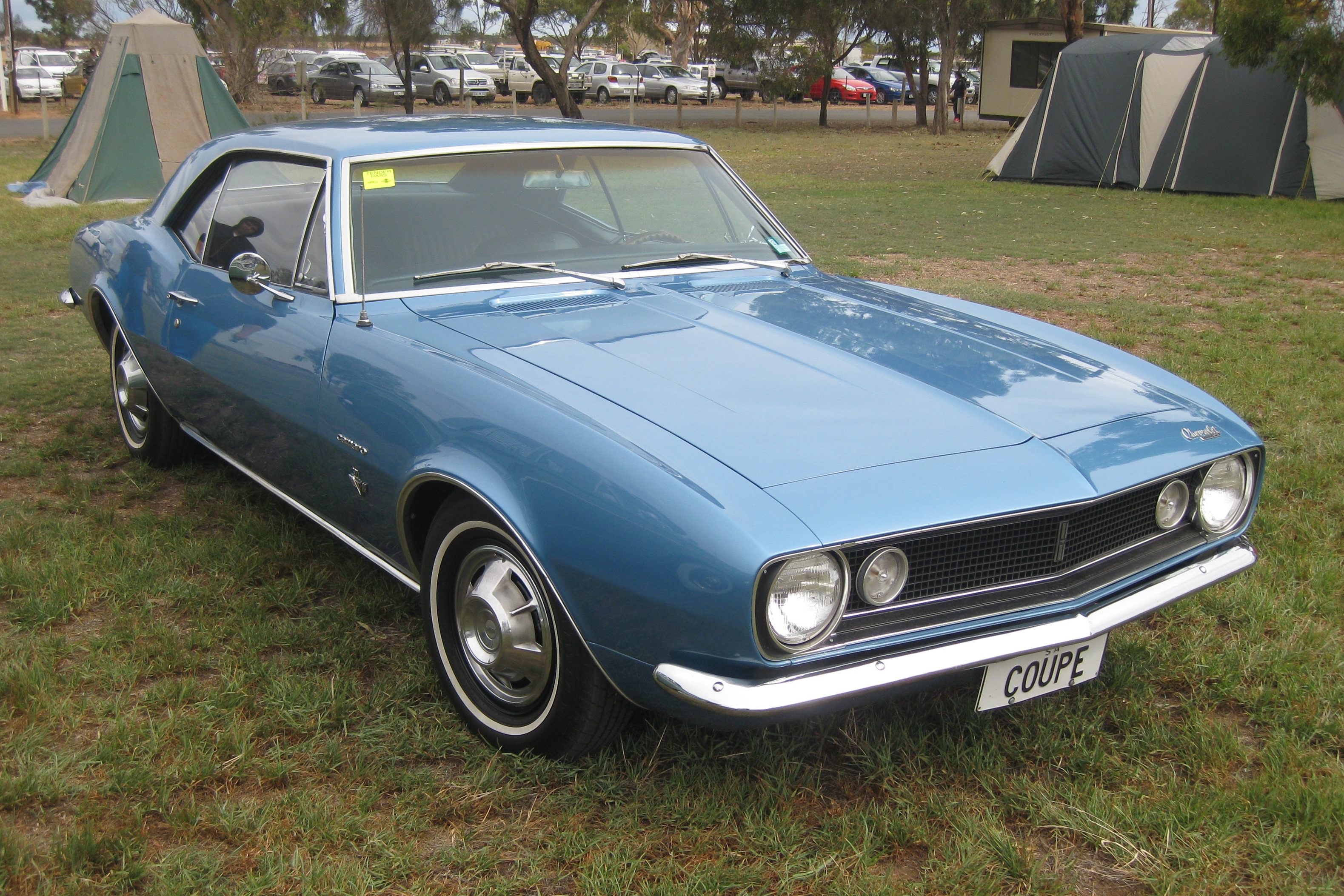
Overview
The Camaro is Chevrolet’s pony-car family, developed to rival the Ford Mustang. Its front-engined, rear-wheel-drive coupe and convertible combined 2+2 seating with six-cylinder or V8 engines. The original F-body architecture was shared with Pontiac’s Firebird. Origins and layout — Carlisle Events.
Chevrolet launched Camaro in calendar year 1966, for the 1967 model year. That distinction matters throughout its history: the revived 2010 model entered production in 2009, and the final 2024-model-year sixth-generation cars were built in 2023. The name therefore does not describe uninterrupted production from 1967 to 2024. Original launch — Chevrolet history, page 11, 2009 restart — GM Oshawa history, production ending — American Cars and Racing.
Generations and design
These are North American model-year ranges, not exact calendar production dates for every body style. Styling revisions within a row do not create an additional generation.
| Generation | Model years | Character and development |
|---|---|---|
| First | 1967–1969 | Established the pony-car identity; RS cars had concealed headlamps, and special-order COPO cars appeared in 1969. |
| Second | 1970–1981 | A longer-running redesign with sleeker styling; substantial exterior revisions followed in 1974 and 1978. |
| Third | 1982–1992 | Angular styling and a hatchback body; fuel injection appeared in 1982, IROC-Z in 1985, and the convertible returned in 1987. |
| Fourth | 1993–2002 | A more rounded design; the 1998 update brought a revised nose and the LS1 V8. |
| Fifth | 2010–2015 | A revival with styling recalling the original Camaro; supercharged ZL1 and competition COPO derivatives followed, with a styling update for 2014. |
| Sixth | 2016–2024 | A further redesign that retained the recognisable shape and added a turbocharged 2.0-litre engine to the range. |
Generation sequence and milestones — Chevrolet Camaro legacy.
The original development programme used the Panther code name. Chevrolet returned to that theme for the sixth generation’s final Collector’s Edition. Panther was a programme name, rather than an earlier production model that Camaro replaced. Development name and retirement announcement — Chevrolet.
Convertible availability did not follow generation boundaries: absent from the second generation, it returned in 1987, then joined the fourth generation for 1994. Body chronology — Carlisle Events.
Engineering and engine families
Early Camaros offered inline-sixes and V8s. Fourth-generation mainstream versions used V6s, with the LT1 V8 in the Z28. The sixth generation adopted GM’s Alpha platform and offered four-cylinder, V6 and V8 versions across its run. Generation-specific engines and Alpha platform — Carlisle Events.
The fifth-generation revival brought a major chassis change: independent rear suspension. Chevrolet’s U.S. 2010 brochure specifies a 3.6-litre direct-injection, dual-overhead-cam V6 and a 6.2-litre V8 for the SS. Even within that SS model year, the manual and automatic versions differed: the automatic V8 included Active Fuel Management, and Chevrolet quoted different outputs for the two combinations. Six-speed manual and automatic transmissions were offered. A displacement alone therefore does not establish the engine specification. 2010 U.S. Camaro brochure, engineering and equipment sections.
Chevrolet described the revived car’s chassis development as an international programme, with testing in Australia, Germany, Sweden and the United States. This is distinct from the location where customer cars were assembled. 2010 U.S. Camaro brochure, chassis development.
Engine availability also changed within the sixth generation. The U.S. 2024 Camaro LT fact sheet specifies a 3.6-litre DOHC V6, a standard six-speed manual and an available ten-speed automatic. Its coupe and convertible bodies were offered in 1LT, 2LT and 3LT trims, with an available RS package. This final-year LT specification should not be backdated to earlier turbocharged LT cars or applied to SS and ZL1 versions. 2024 Camaro LT — Chevrolet technical fact sheet.
Performance names and competition
RS, SS, Z/28 or Z28, IROC-Z, ZL1 and COPO are period-specific packages or derivatives, not generations. RS appearance equipment must also be distinguished from engine designations such as LS1. Historical designations — Chevrolet.
Penske’s Camaro Trans-Am programme won championships in 1968 and 1969 with Mark Donohue, establishing a road-racing reputation alongside the model’s drag-racing associations. Competition history — Carlisle Events.
By the sixth generation, Chevrolet offered specialised track-oriented equipment such as the ZL1 1LE, while Magnetic Ride Control became available on the SS. These developments show how far selected variants evolved beyond the basic sporting-coupe role; their equipment must not be treated as standard across the model family. Sixth-generation performance development — Chevrolet.
Production and regional differences
Camaro manufacture crossed the United States–Canada border over its lifetime. Chevrolet identifies Norwood, Ohio, and Van Nuys, California, as second-generation production sites. Fourth-generation manufacture took place at GM’s Sainte-Thérèse operation in Quebec, alongside the Firebird. The fifth-generation revival was built in Oshawa, Ontario, beginning in 2009; the sixth generation was assembled at Lansing Grand River in Michigan. These sites belong to particular production eras and do not imply that all six generations were built at every plant. Earlier U.S. plants — Chevrolet, Quebec plant history — Le Guide de l’auto, Oshawa — General Motors, Lansing — Chevrolet.
An important regional branch was HSV’s right-hand-drive Camaro programme for Australia and New Zealand. In September 2018 HSV announced the Camaro 2SS automatic, re-engineered from the left-hand-drive vehicle, with local manufacture to commence at Clayton South, Victoria, that month. This was a conversion and re-engineering operation on the imported Chevrolet, not a separate Camaro generation or evidence of factory right-hand-drive availability throughout the range. HSV’s announcement also documents extensive local development, testing and validation. Regional programme — HSV, 10 September 2018.
Production ending and legacy
The first production run ended with the 2002 model year; the fifth generation restored Camaro for 2010. Chevrolet’s March 2023 retirement announcement subsequently identified 2024 as the sixth generation’s last model year and forecast a January 2024 assembly-line ending. The actual finish came earlier: American Cars and Racing reported GM confirmation that production ended on 14 December 2023. The announced schedule and the eventual build date should therefore be kept separate. Retirement plan — Chevrolet, confirmed production finish — American Cars and Racing, 15 December 2023.
Camaro’s historical significance lies in the breadth of one sporting model family: six-cylinder and later four-cylinder versions, V8 performance derivatives, open and closed bodies, and competition programmes all contributed to its identity. Its rivalry with Mustang helped sustain the pony-car category, while its revival connected an established American design identity with modern chassis engineering. The six-generation history is best understood through those distinct eras, rather than through the specification of a single celebrated trim.