Alfa Romeo Giulietta 750/101 Sprint Speciale
The Giulietta Sprint Speciale combined Bertone’s aerodynamic coachwork with Alfa Romeo’s 1.3-litre engineering. Presented in prototype form in 1957, it reached production in 1959 before evolving into the larger-engined Giulia SS.
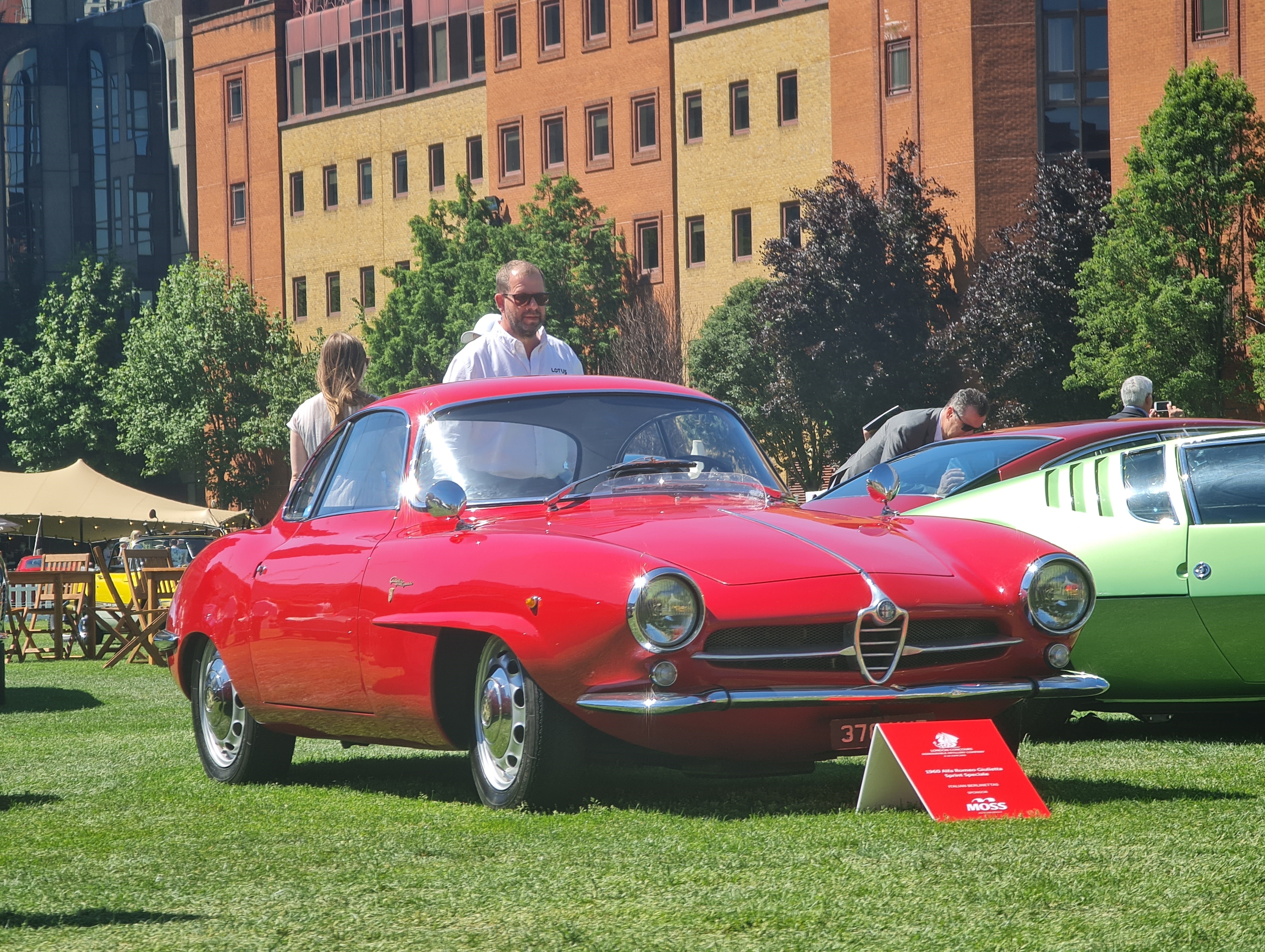
An aerodynamic Giulietta
The Giulietta Sprint Speciale, commonly abbreviated to SS, was a Bertone-bodied sporting coupé within the first-generation Giulietta family. Franco Scaglione designed its distinctive body for Bertone. It stood alongside the conventional Giulietta Sprint, with a separate body design rather than simply an equipment upgrade. Stellantis Heritage identifies both the designer and the SS’s place among the coachbuilt Giulietta derivatives. Manufacturer history.
Built in Italy through the Alfa Romeo–Bertone collaboration, the Giulietta SS belongs to the 1.3-litre phase of Sprint Speciale history. The subsequent 1.6-litre Giulia Sprint Speciale is a distinct successor and should not supply specifications for this record.
Presentation, production and succession
The dates 1957 and 1959 describe different stages. Alfa Romeo’s anniversary account places the Sprint Speciale’s introduction in 1957. The enthusiast history at SprintSpeciale.com distinguishes the prototype shown at the 1957 Turin Motor Show from the production version presented to the press at Monza on 24 June 1959. Accordingly, 1957 is best treated as the presentation year, with 1959 marking the production introduction. These are calendar dates, not market-specific model-year designations. Alfa Romeo anniversary history; Sprint Speciale chronology.
A separate contemporary milestone is the FIA’s GT homologation, number 122, dated 17 May 1959. Homologation establishes competition recognition; it does not by itself establish the first customer delivery. FIA record.
The Giulietta SS continued into the early 1960s before the Giulia SS transition in 1963. The enthusiast chronology identifies the successor’s Geneva presentation in March that year. This transition date should not be read as a verified final assembly date for every Giulietta SS, nor should later Giulia production years be assigned to the 1.3-litre variant.
Body design and aerodynamic development
The SS’s low nose, descending rear window and squared-off tail gave it a recognisably different silhouette from the ordinary Sprint. Stellantis Heritage describes these features as fundamental to Scaglione’s original design, retained substantially in the later Giulia SS. Design continuity.
Alfa Romeo records practical airflow testing on the Milan–Turin motorway: wool strands attached to the body were filmed and photographed from another car to reveal disturbed airflow and guide revisions. This documented development method explains the car’s aerodynamic emphasis without relying on disputed drag-coefficient records. Aerodynamic development.
Engineering and specification boundaries
The FIA identifies the Giulietta Sprint Speciale as a rear-wheel-drive car with four cylinders and 1,290 cc displacement. Alfa Romeo’s retrospective describes a five-speed gearbox with synchronised ratios. These establish the principal mechanical specification without mixing in figures from other Giulietta variants. FIA specification; Alfa Romeo technical account.
The successor retained the Sprint Speciale concept but replaced the 1,290 cc engine with a 1,570 cc twin-cam unit and revised the interior. Its brake changes, output figures and performance therefore belong to the Giulia SS. Stellantis Heritage explicitly describes the larger engine as the central mechanical change. Giulia SS development.
This record does not assign a universal export specification or a single power and top-speed figure across prototype, early production and later cars.
Place in the Giulietta family
The Sprint Speciale illustrates how the Giulietta programme supported distinct coachbuilt interpretations alongside its mainstream models. Bertone’s SS, the Spider and the Berlina belong beneath the same generation, while retaining separate body identities. The continued use of the SS shape for the Giulia successor demonstrates the design’s importance beyond its original engine specification. Giulietta family history.
For the wider chronology, see the Alfa Romeo Giulietta model record.
Sources and image credit
- Alfa Romeo: The Giulietta Is 50 Years Old — development and mechanical context.
- FIA Historic Database: Giulietta Sprint Speciale — homologation 122 and basic specification.
- Stellantis Heritage: Alfa Romeo Giulietta Sprint — designer attribution and family relationships.
- Stellantis Heritage: Giulia SS — continuity of design and successor specification.
- SprintSpeciale.com: History — supplementary presentation chronology.
- MrWalkr / Wikimedia Commons — Giulietta Sprint Speciale photograph, CC BY-SA 4.0.
